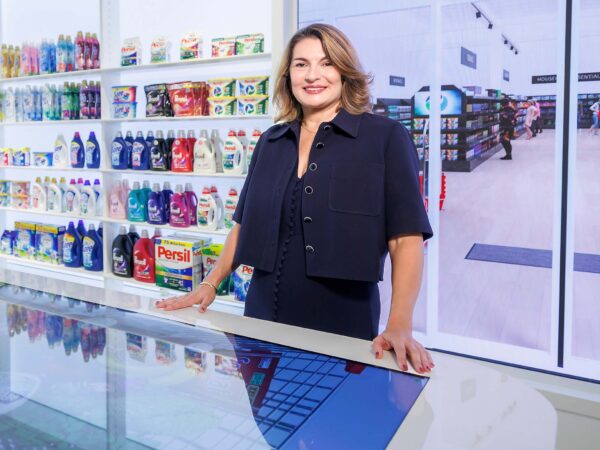
The Head of Quality
Is Decathlon’s Best Customer
In the interview: top manager Claire Blondel.
02/2026

Making sports accessible to everyone – that’s the clear commitment Decathlon stands for. Since its founding in 1976, the company has evolved from a sporting goods retailer into an international, vertically integrated multisport brand. At the heart of the company is the belief that sport brings people together and inspires them – with products that are affordable while meeting the highest quality standards.
Globally responsible for quality is Claire Blondel. As Head of Corporate Quality, she leads a global network of more than 1,000 specialists and ensures product excellence and a customer‑centric quality culture across the organization. Her principles: lead by example, build strong team cohesion, and foster creativity. Her diverse experiences – gained through working and living in six different countries, including China, Japan, and India, and through roles in various sectors, such as her work as a Montessori teacher in education – have strengthened her conviction that these human skills are essential for driving lasting change.
In this interview, we explore how Decathlon defines quality, what lies behind the company’s “value for money” promise, how its products are consistently aligned with customer needs, and which products particularly excite the quality leader – who is, notably, a dedicated Decathlon customer herself.
Mrs. Blondel, how does Decathlon define quality?
Claire Blondel: At Decathlon, we define quality as delivering an excellent product – and an excellent product always keeps its promises, anytime and anywhere. Concretely, this means every product must maintain the same level of excellence throughout its intended lifespan, regardless of where it is produced or where customers can purchase it. It’s a global promise. When we talk about quality promises, we distinguish between implicit and explicit commitments. Implicit promises cover compliance with regulations and, of course, safety – these are the fundamental requirements. Explicit promises refer to any claims we make about the product, whether communicated by sales associates in our stores, on our website, or on the packaging. These include everything we state about performance and benefits, such as, for example, the warmth, waterproofness, or robustness of a jacket. In short, quality for us is about consistently delivering on both the essential standards and the promises we make to our customers.
What tangible effects does your quality approach have on Decathlon’s market positioning, particularly regarding brand image and price?
What we at Decathlon strive for is an exceptional value for an affordable price. That’s exactly Decathlon’s positioning actually in the sports market. To give you an example and make it more concrete: A renowned French consumer magazine recently published a comparison of basic cotton t-shirts. In total, 22 t-shirts from different manufacturers with prices ranging from 4 to 90 euros were compared regarding criteria such as robustness, color fastness, and dimensional stability. They also included one t-shirt from Decathlon with a price of five euros in this benchmarking – and it achieved fourth place in the product ranking. That example perfectly highlights that affordable doesn’t have to mean cheap – and that it doesn’t rule out high product quality.
How do you control quality?
Quality control for us starts with thorough lab testing for every product we make. And we don’t limit ourselves to standard regulatory tests. Instead, we design our testing methods around the needs of our customers. By studying how they actually use our products, we know exactly which stresses to replicate in the lab. For example, for our hiking shoes, we have developed a machine that simulates walking under water on wet stones and sharp branches – conditions that truly challenge footwear. These tests go far beyond what’s required by regulations and are something in which we truly stand out from the competition.
Following up on what you said: How does Decathlon concretely engage with its customers to find out about their experiences?
At Decathlon, we really see customers as part of the design process. As the quality leader of the company, I love to visit the stores to speak with our customers in person and understand their needs firsthand. Because we’re vertically integrated, we can communicate directly with them, which makes gathering feedback much easier than for other sports brands that rely on third-party retailers. Beyond that, we have a so-called co-creation platform, where we invite customers to collaborate with us in designing new products by sharing their input on style, colors, comfort, even sizing. After that, every product goes through short-term and long-term field tests with real users to validate design choices. We also rely heavily on customer reviews, which are one of our key quality indicators. And because customers return products directly to our stores, we get very clear and reliable information about which items come back, in what quantities, and for which defects. This direct feedback loop is incredibly valuable for us to continuously improve the quality of our products.
How do artificial intelligence and digital technologies influence quality management at Decathlon?
We primarily use AI in product design, where we run tests on digital twins to evaluate characteristics such as robustness and the sustainability of a product before creating the master sample. This approach helps us save both time and resources. Additionally, we plan to leverage AI to predict potential product failures based on specific designs and insights from past experiences. By doing this early in the process – before moving to physical prototypes – we can ensure higher quality and greater efficiency.

A more personal question: In which area do you personally never compromise quality?
Safety, for sure. Whenever I make an important purchasing decision – whether it’s choosing a car, booking a flight, or anything where safety is truly at stake – I always prioritize the brand that demonstrates a real commitment to quality. It’s not necessarily the most expensive one, but it has to be the one that proves that safety is at the core of its strategy and values.
And obviously that also goes into your work at Decathlon then. Is there any product that has surprised you the most?
That’s a good question, as I’m a true Decathlon customer myself. My husband even jokes that I’m personally responsible for the company’s turnover (laughs). What I love about our products is how simple, yet incredibly smart, they are. We observe real customer pain points – often small things that make sports harder than they should be – and design solutions that make activities easier and more accessible. One product that really surprised me is our women’s winter cycling tights. I don’t like being cold, so in winter it takes real motivation for me to go outside. These tights have a discreet back zipper that lets you take a quick break without removing layers. It’s such a simple idea, yet it makes a real difference.
One simple question before we close: What is the last Decathlon product you bought?
The last product I bought was a massage cream, which is incredibly effective for muscle stiffness. That’s probably a product people wouldn’t immediately associate with us and demonstrates the huge variety of products we offer. We operate in nearly 60 countries and cover everything from nutrition and creams to textiles, tents, electronics, and even e‑bikes. Ensuring consistent quality across such different product categories and regulatory frameworks is extremely complex. That’s why we rely on a large international team that supports us with testing and compliance.
Quality Wins!